A new kind of gay adolescent was appearing on the page — proud, resilient, sometimes even happy. We profiled many of them in the magazine, including a seventh grader in suburban Philadelphia who was out to his classmates and a high-school varsity-football player from Massachusetts who came out to his teammates and was shocked to find unconditional support.
Showing posts with label young people. Show all posts
Showing posts with label young people. Show all posts
28 September 2009
Coming out young
This is a really great feature article from the New York Times about how more and more kids are identifying as gay or bisexual in middle school, when they're 11 or 12 years old.

11 September 2009
Melvin Burgess on Anne Fine
This tickled me:
From Melvin Burgess' blog.
I think Anne Fine is wrong to suggest that it is hard to get back to an optimistic view without wandering into Ginger Beer land – I think that’s a view she holds because she is principally a pessimist about the world. I think there’s a great deal of hope in the world. You only have to look at the current crop of teenagers, and how they cope with all the nonsense we dump on them, to see that.
From Melvin Burgess' blog.
10 September 2009
Are you old enough?
I did a great session last night at Loreto Mandeville Hall, talking to year 5, 6 and 7 girls and their mothers. It was heaps of fun, and I think everyone enjoyed themselves (I particularly enjoyed the home-made pink cupcakes and pink champagne).
A couple of the parents were asking me whether I thought their daughters were old enough to read my books, which is a question I get asked quite a bit. Here's my answer:
My mum never controlled what I read. There was nothing I wasn't allowed to read. In Grade 4, I read Lord of the Rings (I skipped a lot of the boring bits). In Grade 6 I read the Clan of the Cave Bear and its assorted sequels - complete with explicit sex scenes and 'throbbing members'. I don't think reading stuff I wasn't developmentally ready for damaged me in any way.
Reading is active. You have to physically engage your eyes and your brain in order to read. It's not like TV where it comes to you. Time and time again, studies have shown that if a child is uncomfortable with something they're reading - they'll put it down.
I'm not a parent, so I can only give my perspective as an ex-child, and as someone who knows a bit about reading and literature. I think if a young person wants to read a book - let them. If you are worried about some of the content in the book then make sure you read it as well, then talk to your kids about it. Parents should always talk to their kids about what they're reading. Talking about books is one of the great pleasures of being a reader.
A couple of the parents were asking me whether I thought their daughters were old enough to read my books, which is a question I get asked quite a bit. Here's my answer:
My mum never controlled what I read. There was nothing I wasn't allowed to read. In Grade 4, I read Lord of the Rings (I skipped a lot of the boring bits). In Grade 6 I read the Clan of the Cave Bear and its assorted sequels - complete with explicit sex scenes and 'throbbing members'. I don't think reading stuff I wasn't developmentally ready for damaged me in any way.
Reading is active. You have to physically engage your eyes and your brain in order to read. It's not like TV where it comes to you. Time and time again, studies have shown that if a child is uncomfortable with something they're reading - they'll put it down.
I'm not a parent, so I can only give my perspective as an ex-child, and as someone who knows a bit about reading and literature. I think if a young person wants to read a book - let them. If you are worried about some of the content in the book then make sure you read it as well, then talk to your kids about it. Parents should always talk to their kids about what they're reading. Talking about books is one of the great pleasures of being a reader.
22 July 2009
Mark Day in The Australian wrote an article that said this:
Below is my response.TEENAGERS are not like us. They grunt rather than converse, slouch rather than walk, sleep till noon and their preferred dress is grunge—any black T-shirt featuring gross green slime dripping from a skull will do. They don’t read, don’t pay for music, don’t listen to adults and don’t care about Twitter.
Hi Mark,
I run a website for teenagers about books and reading at the State Library of Victoria, and I wanted to bring a couple of things to your attention after reading your article in the Australian on Monday.
You're wrong when you say young people don't read. Really wrong. In Australia last year, six of the top ten bestsellers in ALL genres were young adult fiction titles. In the US, Borders is ditching their music/DVD sections and replacing them with sprawling teen sections to capitalise on the enormous boom in young adult fiction. Last year, booksales as a whole dropped 4.7%, but YA sales were up 13%. Our website gets thousands of visitors a day, young people desperate to talk about their favourite books. Young people respond creatively to the books they read, with fan fiction, art and music. They love literature so much that they want to spend more time with the characters they love.
The "fragmented, flipperty-gibbet" teens you disparage so flippantly are the most active generation in terms of volunteering, working for charity organisations, and engaging in issues like climate change and human rights. They are socially aware and active. Last year in the US thousands of teens and YA authors banded together in an online community called YA for Obama. The young people were frustrated that they couldn't vote in the US election, and were eager to find other ways that they could make a difference and affect social change. I attended an online chatroom in YA for Obama during one of the Presidential Debates, and found the room full of not just Americans, but British kids up past their bed time and Australians in the computer room at school on their lunch break. And let me tell you, these teenagers had a more comprehensive understanding of the complexity of the US political system than, I suspect, the vast majority of American voting adults. They knew about and cared about the issues. They had opinions, and were desperate to make a difference.
And sure, there's plenty of them who don't read newspapers. But for every teen you find me who doesn't read a newspaper, I'll find you fifty adults who don't either.
However, if you did want teenagers to start reading your newspaper, I'll offer you three suggestions.
1. Stop filling your pages with poorly-researched offensive comments about them.
2. Include content that is relevant to a teenage audience. Hey, you could even publish some content written by teenagers (The Guardian does this regularly with enormous success).
3. Start the newspaper reading habit early. Have a children's section of the paper. A REAL children's section, not a token half page with a Wordsearch puzzle. Address news stories that are relevant to kids and write them in a language they'll understand. You can find examples of this in Canada and the UK.
It's a shame that our society - and in particular our media - seem to be so obsessed with dragging new generations down. It would be awesome to see a little more encouragement of young people, and a little less small-minded snippery.
Regards,
Lili Wilkinson.
31 March 2009
Pink is uncool? ORLY?
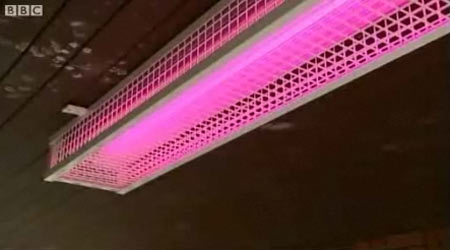 Here’s the latest entry in the “grownups are all bastards” file.
Residents of a Nottinghamshire housing estate have installed pink lights which show up teenagers’ spots in a bid to stop them gathering in the area.And:
Yobs are being shamed out of anti-social behaviour by bright pink lights which show up their acne.(from this BBC story)
The lights are so strong they highlight skin blemishes and have been successful in moving on youths from troublespots who view pink as being “uncool.”
…
Manager Dave Hey said: “With the fluorescent pink light we are trying to embarass young people out of the area. “The pink is not seen as particularly macho among young men and apparently it highlights acne and blemishes in the skin.
Nice, huh?
SPEAKING OF PINK
Stay tuned until tomorrow, when I shall reveal the cover of my next book! It is PINK and it is MADE OF AWESOME.
24 February 2009
Books and Sundays
On Sunday, 50 young people, six authors and other assorted interested/ing individuals gathered at the State Library, to hear two additional authors talk about stuff, and eat cake.
The authors on stage were Simmone Howell and Justine Larbalestier. They were awesome. It was all awesome. The cake was awesome.
And it made me really happy, because it kind of felt like coming home. I’ve been working at the Centre for Youth Literature for nearly six years now*, but I’ve been involved for a lot longer.
The first CYL event I went to, a Bookgig at
Here’s a photo of that first Bookgig. See if you can find Tiny Lili**.

*ZOMG.
**Clue: Jeans too short. White socks. Otherwise, I haven't really changed.
10 November 2008
The Kids are Alright
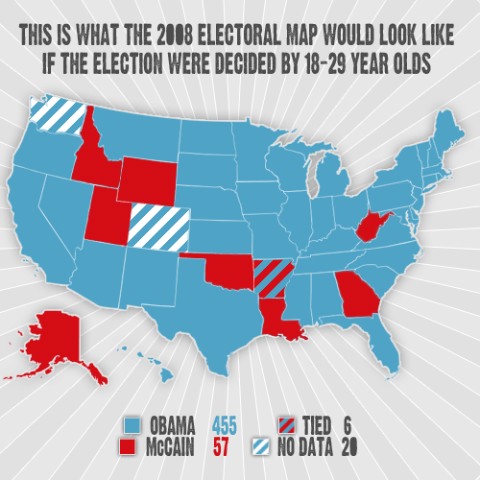
You know the one age group of Californians who voted against Proposition 8?
CNN exit poll*
Vote by Age Yes No
18-29 39 61
30-44 55 45
45-64 54 46
65+ 61 39
Proposition 8, for those of you who might not know, was a proposed constitutional amendment that would make gay marriage illegal in California. It passed, being the one nasty small-minded smudge on what was otherwise a proud day for America.
But have a look at those numbers. The only group who voted No - voted against discrimination - was the young people.
Have a look at this map, sent to me by the wondrous Snazzy.
It's often easy to cry that the world is going to hell-in-the-proverbial, but sometimes it helps to take a step back. Yes, there is still sexism, homophobia, religious intolerance, religious fanaticism, poverty, discrimination, global warming and racism in the world. But we're getting better. Overall, long-term, things are getting better. And from what I see in the world, and what the data above suggests, is that, over time, we are becoming more open-minded, more unprejudiced, more understanding**.
Here, also from Snazzy, is a letter written by an eight-year-old Filipino-American girl to Barack Obama with some advice about a dog, and a request that he make a law that requires everyone to recycle, and also ban unnecessary wars***.
In Obama's response, he writes, "I want you to look up the word 'empathy' in the dictionary. I believe we don't have enough empathy in our world today, and it is up to your generation to change that... I hope you will always be an active participant in the world around you, and that you will seize every opportunity to make the world better. Seeing young people like you who care about making things better inspires me and gives me great hope about the future of our country."

In today's New York Times Op-Ed, Al Gore proposes to make all of the US's electricity renewable within 10 years. The article is passionate and practical, and I highly recommend you read it (especially you, Mr Rudd). But here is the bit that made me cry:
Looking ahead, I have great hope that we will have the courage to embrace the changes necessary to save our economy, our planet and ultimately ourselves.
In an earlier transformative era in American history, President John F. Kennedy challenged our nation to land a man on the moon within 10 years. Eight years and two months later, Neil Armstrong set foot on the lunar surface. The average age of the systems engineers cheering on Apollo 11 from the Houston control room that day was 26, which means that their average age when President Kennedy announced the challenge was 18.
This year similarly saw the rise of young Americans, whose enthusiasm electrified Barack Obama’s campaign. There is little doubt that this same group of energized youth will play an essential role in this project to secure our national future, once again turning seemingly impossible goals into inspiring success.
People often ask me why I write for teenagers. This is why.
______________________________
*Nicked from this post by Justine.
**I was going to say "more tolerant", but I've made a personal pledge to stop using that word. The dictionary tells me that "tolarate" means "to accept or endure something unpleasant or disliked with forbearance". It's a horrible thing to say (I'm looking at YOU, Palin).
***She is an Obama fan despite the fact that her parents are named John and Cindy. For serious.
17 October 2008
Video Friday: Election Special
Here is Hayden Panatierre talking about John McCain:
And here is the entire cast of Gossip Girl talking about John McCain.
And finally and most lolsomely, here is Martin Sheen giving Paris Hilton some advice on her fake Presidency.
And here is the entire cast of Gossip Girl talking about John McCain.
And finally and most lolsomely, here is Martin Sheen giving Paris Hilton some advice on her fake Presidency.
See more Paris Hilton videos at Funny or Die
09 October 2008
YA for Obama
It's interesting how YA authors don't talk about politics.
But this year it's different. Here's Scott Westerfeld:
YA for Obama* is a social network for authors of Young Adult literature, and their readers. It provides information about the candidates, strategies for helping out, and opinion essays from authors such as Judy Blume, Scott Westerfeld, Meg Cabot, John Green, Lauren Myracle, Cecil Castellucci, Sara Zarr, Gossip Girl's Cecily von Zeigasar and Maureen Johnson, the mastermind behind the site.
The idea behind the site is - just because you're under 18, doesn't mean you can't make a difference. And it seems to be working. The site has nearly 1300 members, all contributing tips and strategies, from transporting seniors and people without cars to polling booths on election day, to letter-writing campaigns, to (shock horror) talking to your family about how they will use their vote.
Sex, drugs, rock n roll, rape, incest, self-harm, even occasionally religion. Fine. Bring it on!
But politics? Irresponsible. Swaying the impressionable minds of the young. Just Not On.
But this year it's different. Here's Scott Westerfeld:
Since we've started YA for Obama, a few folks have asked, "How dare we?" As in, how dare we muddy our special duties as tribunes of youth with something as icky as politics.
We answer: "But our books are all about sexuality, racism, the future, who's got money and who hasn't, and figuring out your place in the world. What could be more political than that?"
They say: "Yeah, but those are all pleasantly fuzzy moral issues, which teens should be thinking about. But YA for Obama is about real politics---like, it contains the names of actual politicians. And that's just too . . . specific!"
YA for Obama* is a social network for authors of Young Adult literature, and their readers. It provides information about the candidates, strategies for helping out, and opinion essays from authors such as Judy Blume, Scott Westerfeld, Meg Cabot, John Green, Lauren Myracle, Cecil Castellucci, Sara Zarr, Gossip Girl's Cecily von Zeigasar and Maureen Johnson, the mastermind behind the site.
The idea behind the site is - just because you're under 18, doesn't mean you can't make a difference. And it seems to be working. The site has nearly 1300 members, all contributing tips and strategies, from transporting seniors and people without cars to polling booths on election day, to letter-writing campaigns, to (shock horror) talking to your family about how they will use their vote.
You don't have to be an author to join. You don't have to be a teenager. You don't have to be American. You just have to care. And it also helps if you think that the free world shouldn't be run by a zombie and a moose-hunting beauty queen who can see Russia from her house.
Here's Scalzi on whether or not authors should talk about politics. And here's Paolo Bacigalupi. And here (in case you were wondering on where I stand on this issue) is a video of John McCain referring to his fellow Americans as his "fellow prisoners". That slippery Freud!

Here's Scalzi on whether or not authors should talk about politics. And here's Paolo Bacigalupi. And here (in case you were wondering on where I stand on this issue) is a video of John McCain referring to his fellow Americans as his "fellow prisoners". That slippery Freud!
___________________________________
*for those who are curious: yes, there is a YA for McCain. It has five members.
*for those who are curious: yes, there is a YA for McCain. It has five members.
21 August 2008
Back to Anthony McGowan
Remember this post about Anthony McGowan's opinions on Pink Books?
Well the post received an anonymous comment that implies it's from McGowan. If it isn't, I sincerely apologise to Mr McGowan. If it is, he should maybe think about being a little less anonymous.
Anyway. I thought I'd just copy the anonymous comment, and my response. FYI*.
Here's what he originally said:
Anonymous said...
lili said...
_________________________________
*Why does this always happen to me? First Frank Cottrell Boyce, now Anthony McGowan.
Well the post received an anonymous comment that implies it's from McGowan. If it isn't, I sincerely apologise to Mr McGowan. If it is, he should maybe think about being a little less anonymous.
Anyway. I thought I'd just copy the anonymous comment, and my response. FYI*.
Here's what he originally said:
And here are his response, and my response:The leathery-skinned hacks who churn out the Pink books present a vision of young people as self-obsessed, shallow, blind automata, swilling about in a moronic inferno. Reading these books will leave your soul as shrivelled as one of those pistachios you sometimes find, blackened, in the bottom of the bag. Teenage girls, read the Brontës, read Elizabeth Gaskell, read George Eliot, read anything else - even Jane Austen - but keep the pink off your shelves.
Anonymous said...
In case you didn't notice, all the authors i recommended were women, so cut the white man bullshit. And the author i had in mind was Louise Rennison - read three of her books, as a judge in various competitions. I can't deny there was little of the wind up about the blog, but I'd still stand by every word.
lili said...
Hi "Anonymous",
I would much rather the youth of today read Louise Rennison than anything by the Brontës (the very definition of "self-obsessed, shallow, blind automata, swilling about in a moronic inferno", in my opinion).
And it's a bit rich to dismiss a whole genre based on one author's work. There are some amazing Pink books out there that are challenging, thought-provoking and empowering - Meg Cabot's Ready or Not is an example that springs to mind.
Can you say the same things about your books? Are The Bare Bum Gang books challenging, thought-provoking and empowering for their young readers?
I haven't read them, so I can't say.
Best,
Lili Wilkinson.
_________________________________
*Why does this always happen to me? First Frank Cottrell Boyce, now Anthony McGowan.
17 July 2008
Little Brother by Cory Doctorow
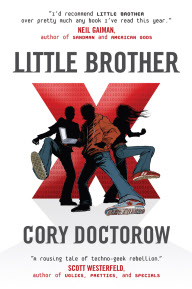 I devoured this book over two days.
It's scary.
Really scary.
Scary in the way that 1984 is but times a million, because 1984 is about a future that never happened, but Little Brother is about right now.
Basically, it's about what happens after a terrorist attack in San Francisco. Marcus, a relatively normal 17 year old with a penchant for minor hackery, gets arrested by the Department of Homeland Security for being found near the attack site without a good excuse. He is taken to a secret offshore prison, tortured, and then forced to sign a document stating that he was held voluntarily.
Outside, the DHS is taking over. Civil liberties are being stripped from citizens who happily allow it because it's making them safer. A general air of terror and paranoia lies over everything. And Marcus can't help wondering - who are the real terrorists, here?
It's an extraordinary novel that every teenager should read. Every adult should read it too, but it's young people who really need to read it. I think it'll really speak to the new generation of technology and news-savvy kids who are growing up in a world where fear and secrecy are considered to be the same thing as security*.
The world is a scary place, and it's easy to believe that there's nothing you can do - especially if you belong to one of the most politically disenfranchised groups of people in the world - young people. Hopefully Little Brother will encourage them to take a little turf back.
You can buy the book here, or download the whole thing for free in just about any format you can imagine here.
___________________________
*Plus, there's sex!
17 May 2008
Escaping: Part 3
(this is a true story)
The PHONE rings.
LILI: (answering) Lili Wilkinson.
LADY ON PHONE: Hi. I believe you've got my son.
LILI: I'm sorry?
LADY: My son. You're holding my son.
LILI: Your son.
LADY: Yes. My son. You're holding him.
LILI: (looks around) I don't think I am.
LADY: I got a message. He's being held there.
LILI: Where exactly do you think this is?
LADY: The Victorian Juvenile Detention Centre.
LILI: Ah. No. Sorry. We're in the business of escapism here, not jailing.
SCENE: CYL OFFICE, STATE LIBRARY OF VICTORIA
The PHONE rings.
LILI: (answering) Lili Wilkinson.
LADY ON PHONE: Hi. I believe you've got my son.
LILI: I'm sorry?
LADY: My son. You're holding my son.
LILI: Your son.
LADY: Yes. My son. You're holding him.
LILI: (looks around) I don't think I am.
LADY: I got a message. He's being held there.
LILI: Where exactly do you think this is?
LADY: The Victorian Juvenile Detention Centre.
LILI: Ah. No. Sorry. We're in the business of escapism here, not jailing.
15 May 2008
Escaping: Part 2
Dr Mark Norman, Senior Curator of Molluscs at Museum Victoria, likes escaping too.
He says that non-fiction helps kids escape into the real world.
Which is a Good Thing to say, because lots of people say that non-fiction isn't really reading. Which is nonsense, but provides me with an exellent segue to provide you with a snippet from my talk from the Emerging Writers Festival last weekend:
He says that non-fiction helps kids escape into the real world.
Which is a Good Thing to say, because lots of people say that non-fiction isn't really reading. Which is nonsense, but provides me with an exellent segue to provide you with a snippet from my talk from the Emerging Writers Festival last weekend:
David Fickling,
But if you’re a young person, and you’re a bit scared of this whole
13 May 2008
Escaping: Part 1
At his keynote at the CBCA conference, Neil Gaiman talked about escapism and imagination. He said (in response to a previous keynote bagging Rowling for being a crap writer), that there is no such thing as a bad book, because reading is a contract between a reader and a writer, and when it comes to children's books, the reader does a lot of the work.
Gaiman told us about this book he read as a child. One part he remembered particularly clearly. The torches on the hill, the dark, terrifying night. The smell of smoke. The glint of firelight on the river below. The restlessness of men and horses, before the battle. On returning to the book as an adult, Gaiman was shocked to find the actual words that conveyed all of these pictures:
"Gosh, what a dark and scary night it is," said Margaret.
So, Gaiman told us, it doesn't really matter if the writer isn't doing her job. Because young readers will do it for her. And that we shouldn't try to prevent children from reading crap, because you can grow a lot of good stuff in crap.
It's not really an excuse for shoddy writing, though, and Gaiman emphasised how important it is to write good books for children. Think of how many people have only ever consumed cheap, nasty wine/whiskey/sushi, and then assumed that they didn't like it, and never tried it again. It could be the same for kids; if the first book they read is shit, then they might think they don't like reading.
Anyway. This isn't very coherent, so I shall finish by reminding you of Chesterton via Gaiman.
The only kind of people who complain about escape, and escapism, are jailers.
Gaiman told us about this book he read as a child. One part he remembered particularly clearly. The torches on the hill, the dark, terrifying night. The smell of smoke. The glint of firelight on the river below. The restlessness of men and horses, before the battle. On returning to the book as an adult, Gaiman was shocked to find the actual words that conveyed all of these pictures:
"Gosh, what a dark and scary night it is," said Margaret.
So, Gaiman told us, it doesn't really matter if the writer isn't doing her job. Because young readers will do it for her. And that we shouldn't try to prevent children from reading crap, because you can grow a lot of good stuff in crap.
It's not really an excuse for shoddy writing, though, and Gaiman emphasised how important it is to write good books for children. Think of how many people have only ever consumed cheap, nasty wine/whiskey/sushi, and then assumed that they didn't like it, and never tried it again. It could be the same for kids; if the first book they read is shit, then they might think they don't like reading.
Anyway. This isn't very coherent, so I shall finish by reminding you of Chesterton via Gaiman.
The only kind of people who complain about escape, and escapism, are jailers.
08 May 2008
Short

Check out Short, a new anthology edited by me!
It's lots of stories, pictures and bits by some famous people*, some new people, and some young people.
I really love the format of the book - it's pretty much pocket-sized, and it has a flip book of a jumping dog in each page corner.
It's a bit strange having a book with my name on it, when I didn't write any of it (except the introduction), but the whole process of curating the book - selecting the pieces, working on them with the writers, organising them into some kind of coherent flow - was a really amazing learning experience.
Available at a good bookshop near you, etc. Oh, and all royalties go to Big Brothers, Big Sisters.
It's a bit strange having a book with my name on it, when I didn't write any of it (except the introduction), but the whole process of curating the book - selecting the pieces, working on them with the writers, organising them into some kind of coherent flow - was a really amazing learning experience.
Available at a good bookshop near you, etc. Oh, and all royalties go to Big Brothers, Big Sisters.
_______________
*including Penni Russon, Andy Griffiths, Tessa Duder, Steven Herrick, Julia Lawrinson and Simmone Howell. Just to name a few.
08 February 2008
Overheard in Melbourne Central
Skanky Teen Girl #1: Ohmigawd, have youse read that book Twilight?
Skanky Teen Girl #2: Huh?
STG #1: Twilight? It's Stephanie Meyer? It's the BOMB.
STG #2: Books? Yuck?
STG #1: No, I know that, you know, teachers say you fall in love with a character in a book? And I'm all like gross? That's so dumb? But I swear, chapter one of Twilight and I just... you just... he's so...
STG #2: Shut up. Let's go to Supré .
Skanky Teen Girl #2: Huh?
STG #1: Twilight? It's Stephanie Meyer? It's the BOMB.
STG #2: Books? Yuck?
STG #1: No, I know that, you know, teachers say you fall in love with a character in a book? And I'm all like gross? That's so dumb? But I swear, chapter one of Twilight and I just... you just... he's so...
STG #2: Shut up. Let's go to Supré .
27 August 2007
Making a difference
Watch this if you're a teacher. No, watch it if you think that being a teacher is a soft option. Just watch it.
16 June 2007
The Good Fight
At the launch of Nick & Norah's Infinite Playlist*, both Ros Price (the publisher) and David Levithan (one of the two authors) said some very nice things.
I don't think it's entirely true to say that the book only got published in Australia because Mike and I pushed so hard for it. The book got published in Australia because it's fucking awesome. We just pointed that out to some people (okay, everyone we met), and Allen & Unwin were nice enough to listen.
It is very gratifying to learn that, when it comes to YA in Australia, my opinions count for something. It's flattering. It also feels like a responsibility.
I have a pile of signed books from Reading Matters, from writers who I respect more than I can say. And many of these authors, above their signatures, thanked me for "fighting the good fight".
This is, in part, a reference to David Levithan's amazing, moving, provocative and inspiring talk about "Killing the Vampires" and making sure the right books get to the teens who really need to see themselves on the shelves of their library.
I can't do justice to what he said with a neat summary. You will have to hear it yourselves. It was a talk for librarians, but everyone needs to hear it. At the conference, it received a standing ovation. I was not the only person moved to tears.
And you need to do more than hear it. You need to copy it, you need to put it on your blog, you need to tell people about it, talk about it, think about it. It has a Creative Commons license, so use it as you will.
Help us fight the good fight.
---------------------------------------------
* review here and first chapter here
I don't think it's entirely true to say that the book only got published in Australia because Mike and I pushed so hard for it. The book got published in Australia because it's fucking awesome. We just pointed that out to some people (okay, everyone we met), and Allen & Unwin were nice enough to listen.
It is very gratifying to learn that, when it comes to YA in Australia, my opinions count for something. It's flattering. It also feels like a responsibility.
I have a pile of signed books from Reading Matters, from writers who I respect more than I can say. And many of these authors, above their signatures, thanked me for "fighting the good fight".
This is, in part, a reference to David Levithan's amazing, moving, provocative and inspiring talk about "Killing the Vampires" and making sure the right books get to the teens who really need to see themselves on the shelves of their library.
I can't do justice to what he said with a neat summary. You will have to hear it yourselves. It was a talk for librarians, but everyone needs to hear it. At the conference, it received a standing ovation. I was not the only person moved to tears.
And you need to do more than hear it. You need to copy it, you need to put it on your blog, you need to tell people about it, talk about it, think about it. It has a Creative Commons license, so use it as you will.
Help us fight the good fight.
---------------------------------------------
* review here and first chapter here
12 June 2007
Ephebiphobia
Dear Mr Schembri,
My friend Jellyfish has just sent me a rather irate email containing a link to your latest offering in The Age.
In response to your '10 key reasons why children should not be allowed in cinemas', I would like to alert you of '1 really key reason why Jim Schembri should not be allowed in print'.
The other day, David Levithan said that homophobia was the last acceptable prejudice. He was wrong. There is another one, and it is ephebiphobia. The fear of young people. (or pedophobia, the fear of children and babies).
Do you think if Jim Schembri had written an article on 10 reasons why we shouldn't let WOMEN or JEWS or BLACK PEOPLE into cinemas, it would have been published?
Why does our society see young people as some kind of lesser species?
Apart from all of the absolute bollocks you see in the media about "teens running wild" and all of the head-shaking and 'in my day'-ing that goes on today, have a think about these 10 things:
1. children as young as 12 can be tried for crimes as adults
2. children can't vote, as they are cited to have a lower level of reasoning. But adults don't have to prove any level of reasoning to vote.
3. the 'lower level of reasoning' line was also used to prevent people with different coloured skins and vaginas from voting up until the 20th century.
4. Senile people have a say in how their country is run. Alcholics and psychotics and murderers and rapists have a say in how their country is run. Not young people.
5. children are forced to attend underfunded schools, have little or no access to free health care, and will have to grow up coping with catastrophic global warming, but have no voice to protest or bring about change.
6. they also have to pay taxes AND superannuation, if they are earning money (not to mention the fucking GST), but with no legal say in how those funds are managed.
7. in the US, poverty among young people exceeds all other age groups, yet the government spends 10 times more on each poor senior than each poor child.
8. you can be a Christian and a child. A Muslim and a child. You can be gay. You can be disabled. You can be poor. You can be homeless. But you're not allowed to have an opinion. (or, if Jim Schembri has his way, go to the fucking cinema)
9. many people in Positions of Influence seem to think that young people should constantly be educated - that books must be either Classics or about Real Issues (see the YA winner of the WA Premier's Award for a recent and tooth-grinding example), television should only be documentaries, and computers are just plain evil.
10. I'll stop ranting now and quote Goosebumps author RL Stine: I believe that kids as well as adults are entitled to books of no socially redeeming value.
Stop picking on the young people. Or at least give them an opportunity to respond.
(With thanks to the NYRA and this episode of the West Wing.)
My friend Jellyfish has just sent me a rather irate email containing a link to your latest offering in The Age.
In response to your '10 key reasons why children should not be allowed in cinemas', I would like to alert you of '1 really key reason why Jim Schembri should not be allowed in print'.
The other day, David Levithan said that homophobia was the last acceptable prejudice. He was wrong. There is another one, and it is ephebiphobia. The fear of young people. (or pedophobia, the fear of children and babies).
Do you think if Jim Schembri had written an article on 10 reasons why we shouldn't let WOMEN or JEWS or BLACK PEOPLE into cinemas, it would have been published?
Why does our society see young people as some kind of lesser species?
Apart from all of the absolute bollocks you see in the media about "teens running wild" and all of the head-shaking and 'in my day'-ing that goes on today, have a think about these 10 things:
1. children as young as 12 can be tried for crimes as adults
2. children can't vote, as they are cited to have a lower level of reasoning. But adults don't have to prove any level of reasoning to vote.
3. the 'lower level of reasoning' line was also used to prevent people with different coloured skins and vaginas from voting up until the 20th century.
4. Senile people have a say in how their country is run. Alcholics and psychotics and murderers and rapists have a say in how their country is run. Not young people.
5. children are forced to attend underfunded schools, have little or no access to free health care, and will have to grow up coping with catastrophic global warming, but have no voice to protest or bring about change.
6. they also have to pay taxes AND superannuation, if they are earning money (not to mention the fucking GST), but with no legal say in how those funds are managed.
7. in the US, poverty among young people exceeds all other age groups, yet the government spends 10 times more on each poor senior than each poor child.
8. you can be a Christian and a child. A Muslim and a child. You can be gay. You can be disabled. You can be poor. You can be homeless. But you're not allowed to have an opinion. (or, if Jim Schembri has his way, go to the fucking cinema)
9. many people in Positions of Influence seem to think that young people should constantly be educated - that books must be either Classics or about Real Issues (see the YA winner of the WA Premier's Award for a recent and tooth-grinding example), television should only be documentaries, and computers are just plain evil.
10. I'll stop ranting now and quote Goosebumps author RL Stine: I believe that kids as well as adults are entitled to books of no socially redeeming value.
Stop picking on the young people. Or at least give them an opportunity to respond.
(With thanks to the NYRA and this episode of the West Wing.)
Subscribe to:
Posts (Atom)