This is Lili's OLD WEBSITE! Go to liliwilkinson.com.au for the shiny, better, more up-to-date, awesome version.

Showing posts with label worthy causes. Show all posts

14 October 2008

An Announcement, Cybils and Human Rights

1. Oddly enough, I don't really talk much about books on this here blog. Mostly because I didn't want it to be a book reviews blog. But I think I'm going to start talking about books a bit more. Not every book I read, but the ones I have something to say about. Stay tuned.

2. I'm going to be a Cybils judge this year! The Cybils are the premier web awards for Children's literature, and I'm a judge for the YA section, along with some hugely awesome people. And there's still time to submit your nomination!

3. And finally, here is a beautiful animation of the Universal Declaration of Human Rights: 

09 October 2008

YA for Obama

It's interesting how YA authors don't talk about politics.

Sex, drugs, rock n roll, rape, incest, self-harm, even occasionally religion. Fine. Bring it on!

But politics? Irresponsible. Swaying the impressionable minds of the young. Just Not On.

But this year it's different. Here's Scott Westerfeld:
Since we've started YA for Obama, a few folks have asked, "How dare we?" As in, how dare we muddy our special duties as tribunes of youth with something as icky as politics.

We answer: "But our books are all about sexuality, racism, the future, who's got money and who hasn't, and figuring out your place in the world. What could be more political than that?"

They say: "Yeah, but those are all pleasantly fuzzy moral issues, which teens should be thinking about. But YA for Obama is about real politics---like, it contains the names of actual politicians. And that's just too . . . specific!"

YA for Obama* is a social network for authors of Young Adult literature, and their readers. It provides information about the candidates, strategies for helping out, and opinion essays from authors such as Judy Blume, Scott Westerfeld, Meg Cabot, John Green, Lauren Myracle, Cecil Castellucci, Sara Zarr, Gossip Girl's Cecily von Zeigasar and Maureen Johnson, the mastermind behind the site.

The idea behind the site is - just because you're under 18, doesn't mean you can't make a difference. And it seems to be working. The site has nearly 1300 members, all contributing tips and strategies, from transporting seniors and people without cars to polling booths on election day, to letter-writing campaigns, to (shock horror) talking to your family about how they will use their vote.

You don't have to be an author to join. You don't have to be a teenager. You don't have to be American. You just have to care. And it also helps if you think that the free world shouldn't be run by a zombie and a moose-hunting beauty queen who can see Russia from her house.


Here's Scalzi on whether or not authors should talk about politics. And here's Paolo Bacigalupi. And here (in case you were wondering on where I stand on this issue) is a video of John McCain referring to his fellow Americans as his "fellow prisoners". That slippery Freud!

___________________________________
*for those who are curious: yes, there is a YA for McCain. It has five members.

07 March 2008

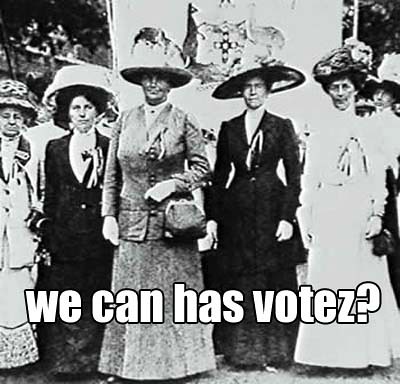
Well done, sister suffragette!

Today is International Women's Day.

It's also the Centenary of Women's Suffrage in Victoria.

New Zealand came first with the whole women-voting thing, in 1893, followed by South Australia in 1902.

In Victoria, the issue was kicked off in 1891 when Premier James Munro said that he'd introduce a bill for Women's suffrage if ordinary women demonstrated they wanted the right. They did. They created the Monster Petition, with 30 000 signatures, in six weeks. The petition was 260 metres long, and several attendants were needed to carry it into Parliament. For some strange reason it took 19 bills and 17 years to actually give women the voting stamp of approval, but that's what happens when all the politicians are men.

The UK gave women the vote in 1918, but it had restrictions until 1928.

The US did it in 1920.

Italy gave women the nod in 1948, as did Belgium, Israel, Iraq and South Korea.

Switzerland didn't have women's suffrage until 1971, nor Lichtenstein, until 1984.

The most recent nation to grant their women the right to vote was the United Arab Emirates. There are still restrictions, which will be lifted by 2010.

We've come a long way, but while you're munching on your purple-iced cupcake and admiring your fancy new blue stockings, spare a thought for the women in the world who are still disenfranchised.

23 February 2008

Saturday morning rant (story v language)

I've been thinking a lot about the war that is being fought between story and language.

It shouldn't be a war. Language and story should work together. But people don't seem to want to let them, and so they fight.

I heard someone say recently that they didn't like books they couldn't put down. This person felt manipulated by a gripping plot. I found this astonishing.

It goes hand-in-hand with the snobbery towards mass-market fiction, chicklit (see Maureen Johnson's awesome post for more on that) and, of course, YA.

Nick Hornby has this to say:

“In a way, I think all books should be teen books. I can read them quickly without getting bogged down, and feel I’ve read something that was meant in the way literature’s supposed to be. They’re very digestible, designed not to bore people.”

But if you have a look at the kind of books that win the Miles Franklin and the Booker, it seems pretty clear that the literati don't agree. Literature needs to be dense, beautiful and obfuscating.

I love beautiful language. Writers like Margaret Atwood (pre-Oryx & Crake), Jorge Louis-Borges and Gabriel Garcia Marquez. And of course the beautiful-language YA writers Ursula Dubosarsky, Margo Lanagan and David Almond. But as well as having a truly magical control over language, all these writers also know how to tell a cracking good story.

Making stories is an art. It's difficult and complex and there are rules and structures, and if you don't want to stick to those rules and structures, then fine, but you'd better have a damn good reason. In my four years of studying creative writing at Uni, not one class mentioned the importance of structure, except of course, for my screenwriting class.

The story vs language brawl spills over into visual media as well. Film can be loved by our intellectual elite because of its 'language' - the cinematography, metaphor and mood. Television, however, is much more reliant on story. Smaller screens, heavily prescribed time limits, and a need for continuity mean that TV shows have more rules and structures.
But that doesn't mean they can't be art, too. There is often more thought, care, craft, put into an episode of The West Wing, Six Feet Under or Veronica Mars, than into a feature film of the kind that our intellectual elite favour.

I'm not really sure where this rant is heading. I suppose it's a plea. Don't be ashamed to read The Da Vinci Code just because it's mass market fiction. There are plenty of other reasons to be ashamed (ie: it's crap). Embrace your love of chicklit (and its cinematic equivalent, the romcom). Read a fantasy novel. Watch Battlestar Galactica.

Yes. There is bad chicklit. And bad fantasy novels. And books like The Da Vinci Code.

But here's a revalation: there's a lot of bad books, full stop. Some of them have won prestigious literary awards.

You will judge a book by its cover - everyone does. I certainly do. But I try not to judge books by what section of the bookshop they are shelved in*.

Send in the peacekeepers! End the war! Give story a chance.

_______________
*This isn't entirely true. I tend to avoid self-help and true-crime. But in terms of fiction, I'm showing the love for all shelves.

13 February 2008

Sorry

Today we honour the Indigenous peoples of this land, the oldest continuing cultures in human history.

We reflect on their past mistreatment.

We reflect in particular on the mistreatment of those who were stolen generations - this blemished chapter in our nation's history.

The time has now come for the nation to turn a new page in Australia's history by righting the wrongs of the past and so moving forward with confidence to the future.

We apologise for the laws and policies of successive Parliaments and governments that have inflicted profound grief, suffering and loss on these our fellow Australians.

We apologise especially for the removal of Aboriginal and Torres Strait Islander children from their families, their communities and their country.

For the pain, suffering and hurt of these stolen generations, their descendants and for their families left behind, we say sorry.

To the mothers and the fathers, the brothers and the sisters, for the breaking up of families and communities, we say sorry.

And for the indignity and degradation thus inflicted on a proud people and a proud culture, we say sorry.

(the rest is here)

23 October 2007

Improve Your Vocabulary - help developing nations!

Check out Free Rice, a project from poverty.com

For every word you correctly label, poverty.com will donate 10 grains of rice to a developing nation.

It's procrastination AND worthy AND promotes literacy!