This is Lili's OLD WEBSITE! Go to liliwilkinson.com.au for the shiny, better, more up-to-date, awesome version.

Showing posts with label YA. Show all posts

23 March 2010

Best YA titles

Adele from Persnickety Snark is compiling a list of the Top 100 YA Novels of All Time. I've just agonised over my own personal Top 10 to add to the list. It was HARD, and I'm sure I've forgotten some. But here they are:
  1. Fire and Hemlock by Diana Wynne Jones
  2. Obernewtyn by Isobelle Carmody
  3. Ready or Not by Meg Cabot
  4. The Curious Incident of the Dog in the Night-time by Mark Haddon
  5. Nick and Norah’s Infinite Playlist by Rachel Cohn and David Levithan
  6. Mandragora by David McRobbie
  7. Alanna: The First Adventure by Tamora Pierce
  8. Skellig by David Almond
  9. Northern Lights by Philip Pullman
  10. Abyssinia by Ursula Dubosarsky
I actually started with a list of 20, and getting it down to 10 felt a bit like murder. So here're the runners-up, all of which I also adore:

Del Del by Victor Kelleher
So Yesterday by Scott Westerfeld
Tender Morsels by Margo Lanagan
Looking for Alaska by John Green
Forever by Judy Blume
The Book of Three by Lloyd Alexander
Space Demons by Gillian Rubenstein
Doing It by Melvin Burgess
48 Shades of Brown by Nick Earls
Mortal Engines by Philip Reeve

What are yours?

31 July 2009

My YA Novel


CREATE YOUR DEBUT YA COVER
1 - Go to "Fake Name Generator" or click http://www.fakenamegenerator.com/

The name that appears is your author name.

2 - Go to "Random Word Generator" or click http://www.websitestyle.com/parser/randomword.shtml

The word listed under "Random Verb" is your title.

3 - Go to "FlickrCC" or click http://flickrcc.bluemountains.net/index.php

Type your title into the search box. The first photo that contains a person is your cover.

4 - Use Photoshop, Picnik, or similar to put it all together. Be sure to crop and/or zoom in.

5 - Post it to your site along with this text.

By the way, I'm going to the UK tonight. If you happen to be at the Edinburgh Festival, come and say hi!

22 July 2009

Mark Day in The Australian wrote an article that said this:

TEENAGERS are not like us. They grunt rather than converse, slouch rather than walk, sleep till noon and their preferred dress is grunge—any black T-shirt featuring gross green slime dripping from a skull will do. They don’t read, don’t pay for music, don’t listen to adults and don’t care about Twitter.

Below is my response.


Hi Mark,

I run a website for teenagers about books and reading at the State Library of Victoria, and I wanted to bring a couple of things to your attention after reading your article in the Australian on Monday.

You're wrong when you say young people don't read. Really wrong. In Australia last year, six of the top ten bestsellers in ALL genres were young adult fiction titles. In the US, Borders is ditching their music/DVD sections and replacing them with sprawling teen sections to capitalise on the enormous boom in young adult fiction. Last year, booksales as a whole dropped 4.7%, but YA sales were up 13%. Our website gets thousands of visitors a day, young people desperate to talk about their favourite books. Young people respond creatively to the books they read, with fan fiction, art and music. They love literature so much that they want to spend more time with the characters they love.

The "fragmented, flipperty-gibbet" teens you disparage so flippantly are the most active generation in terms of volunteering, working for charity organisations, and engaging in issues like climate change and human rights. They are socially aware and active. Last year in the US thousands of teens and YA authors banded together in an online community called YA for Obama. The young people were frustrated that they couldn't vote in the US election, and were eager to find other ways that they could make a difference and affect social change. I attended an online chatroom in YA for Obama during one of the Presidential Debates, and found the room full of not just Americans, but British kids up past their bed time and Australians in the computer room at school on their lunch break. And let me tell you, these teenagers had a more comprehensive understanding of the complexity of the US political system than, I suspect, the vast majority of American voting adults. They knew about and cared about the issues. They had opinions, and were desperate to make a difference.

And sure, there's plenty of them who don't read newspapers. But for every teen you find me who doesn't read a newspaper, I'll find you fifty adults who don't either.

However, if you did want teenagers to start reading your newspaper, I'll offer you three suggestions.

1. Stop filling your pages with poorly-researched offensive comments about them.
2. Include content that is relevant to a teenage audience. Hey, you could even publish some content written by teenagers (The Guardian does this regularly with enormous success).
3. Start the newspaper reading habit early. Have a children's section of the paper. A REAL children's section, not a token half page with a Wordsearch puzzle. Address news stories that are relevant to kids and write them in a language they'll understand. You can find examples of this in Canada and the UK.

It's a shame that our society - and in particular our media - seem to be so obsessed with dragging new generations down. It would be awesome to see a little more encouragement of young people, and a little less small-minded snippery.

Regards,

Lili Wilkinson.

16 April 2009

Sugar and Spice and All Things Not Award-Winning

Last week the Children's Book Council Book of the Year Shortlist was announced. There were sixteen books on the Older Readers Notable list, with six books on the actual Shortlist. Of the sixteen Notables, four books have female protagonists. On the Shortlist, there's just one.

Firstly, congratulations to all the authors on the lists. Please don't think for a moment that what follows is a criticism of your work. You're all awesome and totally deserve to be there.

But where are all the girls? Where is Simmone Howell's Everything Beautiful? Or Joanne Horniman's My Candlelight Novel? Or Michelle Cooper's A Brief History of Montmaray? Or Julia Lawrinson's The Push?

If you take a look back over the years at the books that have won and been shortlisted in the past, you'll notice that there aren't many girls at all (Melina Marchetta's Looking for Alibrandi and Saving Francesca are among the handful of girl-protagonist books awarded the gong in over 60 years).

And it's happening everywhere! Today the Miles Franklin shortlist was announced. How many women writers on the shortlist? NONE. Ironic, huh? For a literary award that was named in honour of a woman who had to pretend to be a man in order to get published. A HUNDRED YEARS AGO.

What's going on? Why, as a society, do we privilege stories about boys and men? Why are their stories more Literary? Is it because people figure that girls will read books about boys, but boys won't read books about girls? Is it because girl-stories are often focussed on an emotion-based arc, rather than an action-based one?

I'm currently in the very early stages of thinking about The Next Book. And I wanted to try writing a book for girls, but with a male protagonist. But now I'm not so sure. More girl books, I say! More spunky girls being awesome! Awards be damned!

(for more on this, check out Kirsty and Adele and Judith)

01 April 2009

PINK

Is it not EPIC WIN!??

24 February 2009

Books and Sundays

On Sunday, 50 young people, six authors and other assorted interested/ing individuals gathered at the State Library, to hear two additional authors talk about stuff, and eat cake.


The authors on stage were Simmone Howell and Justine Larbalestier. They were awesome. It was all awesome. The cake was awesome.


And it made me really happy, because it kind of felt like coming home. I’ve been working at the Centre for Youth Literature for nearly six years now*, but I’ve been involved for a lot longer.


The first CYL event I went to, a Bookgig at St Martin’s Youth Arts Theatre. It was 1993. I was 12. The author was Isobelle Carmody, the book was The Gathering. I went to a whole lot of Bookgigs as a kid, and loved them all. Talking about books with other young people and Real Live Authors seemed to be pretty much the best way to spend a Sunday afternoon, and I’m pleased to say that it still is.


Here’s a photo of that first Bookgig. See if you can find Tiny Lili**.


*ZOMG.

**Clue: Jeans too short. White socks. Otherwise, I haven't really changed.

05 January 2009

Cybils!

The Cybils Finalists are out, and I am getting my read on. The YA finalists are:

Audrey, Wait! by Robin Benway

Ten Cents a Dance by Christine Fletcher

The Disreputable History of Frankie Landau-Banks by E. Lockhart

Jellicoe Road by Melina Marchetta

Sweethearts by Sara Zarr

I Know It's Over by C.K. Kelly Martin

Thaw by Monica M. Roe

So far I've only read Frankie Landau-Banks and Jellicoe Road (known as On the Jellicoe Road here in Oz), and will blog about them presently...

My fellow YA judges are Jackie Parker, Sarah Stevenson, Little Willow and Casey Titschinger. The winners in all categories will be announced February 14th.

You can read about the Cybils, and see the finalists in all categories, here.

14 October 2008

An Announcement, Cybils and Human Rights

1. Oddly enough, I don't really talk much about books on this here blog. Mostly because I didn't want it to be a book reviews blog. But I think I'm going to start talking about books a bit more. Not every book I read, but the ones I have something to say about. Stay tuned.

2. I'm going to be a Cybils judge this year! The Cybils are the premier web awards for Children's literature, and I'm a judge for the YA section, along with some hugely awesome people. And there's still time to submit your nomination!

3. And finally, here is a beautiful animation of the Universal Declaration of Human Rights: 

09 October 2008

YA for Obama

It's interesting how YA authors don't talk about politics.

Sex, drugs, rock n roll, rape, incest, self-harm, even occasionally religion. Fine. Bring it on!

But politics? Irresponsible. Swaying the impressionable minds of the young. Just Not On.

But this year it's different. Here's Scott Westerfeld:
Since we've started YA for Obama, a few folks have asked, "How dare we?" As in, how dare we muddy our special duties as tribunes of youth with something as icky as politics.

We answer: "But our books are all about sexuality, racism, the future, who's got money and who hasn't, and figuring out your place in the world. What could be more political than that?"

They say: "Yeah, but those are all pleasantly fuzzy moral issues, which teens should be thinking about. But YA for Obama is about real politics---like, it contains the names of actual politicians. And that's just too . . . specific!"

YA for Obama* is a social network for authors of Young Adult literature, and their readers. It provides information about the candidates, strategies for helping out, and opinion essays from authors such as Judy Blume, Scott Westerfeld, Meg Cabot, John Green, Lauren Myracle, Cecil Castellucci, Sara Zarr, Gossip Girl's Cecily von Zeigasar and Maureen Johnson, the mastermind behind the site.

The idea behind the site is - just because you're under 18, doesn't mean you can't make a difference. And it seems to be working. The site has nearly 1300 members, all contributing tips and strategies, from transporting seniors and people without cars to polling booths on election day, to letter-writing campaigns, to (shock horror) talking to your family about how they will use their vote.

You don't have to be an author to join. You don't have to be a teenager. You don't have to be American. You just have to care. And it also helps if you think that the free world shouldn't be run by a zombie and a moose-hunting beauty queen who can see Russia from her house.


Here's Scalzi on whether or not authors should talk about politics. And here's Paolo Bacigalupi. And here (in case you were wondering on where I stand on this issue) is a video of John McCain referring to his fellow Americans as his "fellow prisoners". That slippery Freud!

___________________________________
*for those who are curious: yes, there is a YA for McCain. It has five members.

21 August 2008

Back to Anthony McGowan

Remember this post about Anthony McGowan's opinions on Pink Books?

Well the post received an anonymous comment that implies it's from McGowan. If it isn't, I sincerely apologise to Mr McGowan. If it is, he should maybe think about being a little less anonymous.

Anyway. I thought I'd just copy the anonymous comment, and my response. FYI*.

Here's what he originally said:

The leathery-skinned hacks who churn out the Pink books present a vision of young people as self-obsessed, shallow, blind automata, swilling about in a moronic inferno. Reading these books will leave your soul as shrivelled as one of those pistachios you sometimes find, blackened, in the bottom of the bag. Teenage girls, read the Brontës, read Elizabeth Gaskell, read George Eliot, read anything else - even Jane Austen - but keep the pink off your shelves.

And here are his response, and my response:

Anonymous said...

In case you didn't notice, all the authors i recommended were women, so cut the white man bullshit. And the author i had in mind was Louise Rennison - read three of her books, as a judge in various competitions. I can't deny there was little of the wind up about the blog, but I'd still stand by every word.


lili said...
Hi "Anonymous",

I would much rather the youth of today read Louise Rennison than anything by the Brontës (the very definition of "self-obsessed, shallow, blind automata, swilling about in a moronic inferno", in my opinion).
And it's a bit rich to dismiss a whole genre based on one author's work. There are some amazing Pink books out there that are challenging, thought-provoking and empowering - Meg Cabot's Ready or Not is an example that springs to mind.

Can you say the same things about your books? Are The Bare Bum Gang books challenging, thought-provoking and empowering for their young readers?

I haven't read them, so I can't say.

Best,

Lili Wilkinson.


_________________________________
*Why does this always happen to me? First Frank Cottrell Boyce, now Anthony McGowan.

11 August 2008

Anthony McGowan On Pink Books

I know this is a wind-up, but still seems a bit much from the author the Bare Bum Gang books.

OK, so not many teenagers are going to be reading Nietzsche and the Marquis de Sade, but there's a whole world of books that I'd ban straight away if I got the chance: pink books. Yes, down there with Nietzsche and De Sade I'd place those terrible teeny-chick lit "novels", the ones about snogging and boyfriends and make-up and nothing else. The novel is supposed (says who? says me) to exalt the soul, to show humanity what, in its greatest moments, it might achieve; and yet also to reveal our vulnerability and our helplessness.

The leathery-skinned hacks who churn out the Pink books present a vision of young people as self-obsessed, shallow, blind automata, swilling about in a moronic inferno. Reading these books will leave your soul as shrivelled as one of those pistachios you sometimes find, blackened, in the bottom of the bag. Teenage girls, read the Brontës, read Elizabeth Gaskell, read George Eliot, read anything else - even Jane Austen - but keep the pink off your shelves.

From here.

30 July 2008

The (not quite) Perfect Boyfriend

I have a new book out!

It's my first ever Pink Book, and I LOVED writing it. It contains the following things:

-spelling
-secrets
-imaginary boyfriends
-possessed Care Bears
-kissing
-vomit
-live action role playing

Here is an early review.

And here is the publisher's site.

Maybe next week I will post an extract.

20 July 2008

Devil's Advocate

I have this idea that I'm not sure I agree with, but I'm going to talk about it anyway, because that's just how I roll, y'all.

Ahem.

People are getting knickers twisted because of the current slew of YA books that mention brand names. You know, the seven squillion Gossip Girl* clones out there. Where all the kiddies are wearing Burberry and Manolos and whatever else is fashionable right now. And now companies are paying publishers for in-book product placement. So poor Katie H Protagonist is now slapping on Maybelline WetShine Diamonds in Raunchy Red.

And the knicker twisted ones (whose side I am almost completely on, btw) are saying: "how TERRIBLE that companies are using BOOKS to peddle their wares! BOOKS the LAST TRUE BASTION OF CULTURE etc etc.

So my devil's advocate position is this:

Companies are going to advertise their products to teenagers no matter what we do, or say. Nothing will stop that. So wouldn't you rather a Young Person was getting a healthy dose of Reading along with their advertising? Instead of just on a TV commercial or billboard somewhere?

I suppose it depends on what the choice is. If the choice is: Books With Product Placement or Books Without Product Placement, I choose the latter. But if the choice is Advertising With Character Development And Narrative or Advertising On Irritating TV Commercials, I'll take my ads in books.

Does that make sense?

I also wouldn't want it to go too far the other way. In my latest book, I mention Two Minute Noodles, Mars Bars, MySpace, Google and Care Bears. The story wouldn't have felt as real if I'd not been able to use those things. Nothing pulls a reader out of a narrative like the mention of Three Minute Rice, Jupiter Bars, MyArea, Croogle and Solicitude Bears. Of course Google and the Care Bears didn't pay me anything to mention their products. So I suppose that's different.

But still.

You see what I'm saying?

I still haven't convinced myself. But I'm getting there.
___________
*Speaking of Gossip Girl, have you seen the racy new promos? SOLID GOLD.

17 July 2008

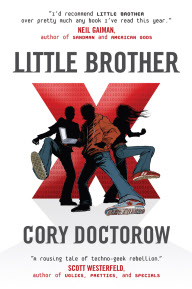
Little Brother by Cory Doctorow

I devoured this book over two days.

It's scary.

Really scary.

Scary in the way that 1984 is but times a million, because 1984 is about a future that never happened, but Little Brother is about right now.

Basically, it's about what happens after a terrorist attack in San Francisco. Marcus, a relatively normal 17 year old with a penchant for minor hackery, gets arrested by the Department of Homeland Security for being found near the attack site without a good excuse. He is taken to a secret offshore prison, tortured, and then forced to sign a document stating that he was held voluntarily.
Outside, the DHS is taking over. Civil liberties are being stripped from citizens who happily allow it because it's making them safer. A general air of terror and paranoia lies over everything. And Marcus can't help wondering - who are the real terrorists, here?

It's an extraordinary novel that every teenager should read. Every adult should read it too, but it's young people who really need to read it. I think it'll really speak to the new generation of technology and news-savvy kids who are growing up in a world where fear and secrecy are considered to be the same thing as security*.

The world is a scary place, and it's easy to believe that there's nothing you can do - especially if you belong to one of the most politically disenfranchised groups of people in the world - young people. Hopefully Little Brother will encourage them to take a little turf back.

You can buy the book here, or download the whole thing for free in just about any format you can imagine here. 
___________________________
*Plus, there's sex!

15 May 2008

Escaping: Part 2

Dr Mark Norman, Senior Curator of Molluscs at Museum Victoria, likes escaping too.

He says that non-fiction helps kids escape into the real world.

Which is a Good Thing to say, because lots of people say that non-fiction isn't really reading. Which is nonsense, but provides me with an exellent segue to provide you with a snippet from my talk from the Emerging Writers Festival last weekend:

David Fickling, UK childrens publisher extraordinaire, started out publishing Goosebumps. And although he has moved on to bigger and better things, he hasn’t forgotten his roots. Goosebumps, The Babysitter's Club, The Guiness Book of Records... David calls these books readermakers. They’re easy books, accessible books. They’re like the white bread equivalent of books – light, insubstantial, and without much dietary fibre.

But if you’re a young person, and you’re a bit scared of this whole Reading thing because you don’t really get it, and everyone keeps telling you how important it is, a Readermaker can be a great thing. Because you pick it up. It’s easy to get into. Pages turn. Before you know it, you’ve finished. You read a whole book. A whole entire book. And it was fun. So you read another one. This reading thing is easy! And because you’re breezing along, you’re a reading gun, you think about picking up something a bit longer. Something a bit harder. And your love of reading has begun. You've escaped.

13 May 2008

Escaping: Part 1

At his keynote at the CBCA conference, Neil Gaiman talked about escapism and imagination. He said (in response to a previous keynote bagging Rowling for being a crap writer), that there is no such thing as a bad book, because reading is a contract between a reader and a writer, and when it comes to children's books, the reader does a lot of the work.

Gaiman told us about this book he read as a child. One part he remembered particularly clearly. The torches on the hill, the dark, terrifying night. The smell of smoke. The glint of firelight on the river below. The restlessness of men and horses, before the battle. On returning to the book as an adult, Gaiman was shocked to find the actual words that conveyed all of these pictures:

"Gosh, what a dark and scary night it is," said Margaret.

So, Gaiman told us, it doesn't really matter if the writer isn't doing her job. Because young readers will do it for her. And that we shouldn't try to prevent children from reading crap, because you can grow a lot of good stuff in crap.

It's not really an excuse for shoddy writing, though, and Gaiman emphasised how important it is to write good books for children. Think of how many people have only ever consumed cheap, nasty wine/whiskey/sushi, and then assumed that they didn't like it, and never tried it again. It could be the same for kids; if the first book they read is shit, then they might think they don't like reading.

Anyway. This isn't very coherent, so I shall finish by reminding you of Chesterton via Gaiman.

The only kind of people who complain about escape, and escapism, are jailers.

01 May 2008

Things

1. I met Julia Gillard today. She was at the launch of the MS Readathon, and said some AWFULLY sensible things about how good it would be if Australia put as much effort into winning at reading, as we did into winning at sport. I have a girl-crush.

2. Boy Toy, by Barry Lyga, is a really good book. I heartily recommend. It's a story that I've read many times before, but never as well as in this case.

3. I am going to pinch two very interesting comments that JL Bell put on Oz and Ends, from a panel:

-"Teen books are like adult books, without all the bullshit." --H Jack Martin.

-"I thought I'd been condescended to because I'm an Indian. That was nothing compared to the condescended to because I've written a YA novel... because I've written a book about a 16-year-old, that means I'm a capitalistic whore." --Sherman Alexie, author of another very good book.

23 February 2008

Saturday morning rant (story v language)

I've been thinking a lot about the war that is being fought between story and language.

It shouldn't be a war. Language and story should work together. But people don't seem to want to let them, and so they fight.

I heard someone say recently that they didn't like books they couldn't put down. This person felt manipulated by a gripping plot. I found this astonishing.

It goes hand-in-hand with the snobbery towards mass-market fiction, chicklit (see Maureen Johnson's awesome post for more on that) and, of course, YA.

Nick Hornby has this to say:

“In a way, I think all books should be teen books. I can read them quickly without getting bogged down, and feel I’ve read something that was meant in the way literature’s supposed to be. They’re very digestible, designed not to bore people.”

But if you have a look at the kind of books that win the Miles Franklin and the Booker, it seems pretty clear that the literati don't agree. Literature needs to be dense, beautiful and obfuscating.

I love beautiful language. Writers like Margaret Atwood (pre-Oryx & Crake), Jorge Louis-Borges and Gabriel Garcia Marquez. And of course the beautiful-language YA writers Ursula Dubosarsky, Margo Lanagan and David Almond. But as well as having a truly magical control over language, all these writers also know how to tell a cracking good story.

Making stories is an art. It's difficult and complex and there are rules and structures, and if you don't want to stick to those rules and structures, then fine, but you'd better have a damn good reason. In my four years of studying creative writing at Uni, not one class mentioned the importance of structure, except of course, for my screenwriting class.

The story vs language brawl spills over into visual media as well. Film can be loved by our intellectual elite because of its 'language' - the cinematography, metaphor and mood. Television, however, is much more reliant on story. Smaller screens, heavily prescribed time limits, and a need for continuity mean that TV shows have more rules and structures.
But that doesn't mean they can't be art, too. There is often more thought, care, craft, put into an episode of The West Wing, Six Feet Under or Veronica Mars, than into a feature film of the kind that our intellectual elite favour.

I'm not really sure where this rant is heading. I suppose it's a plea. Don't be ashamed to read The Da Vinci Code just because it's mass market fiction. There are plenty of other reasons to be ashamed (ie: it's crap). Embrace your love of chicklit (and its cinematic equivalent, the romcom). Read a fantasy novel. Watch Battlestar Galactica.

Yes. There is bad chicklit. And bad fantasy novels. And books like The Da Vinci Code.

But here's a revalation: there's a lot of bad books, full stop. Some of them have won prestigious literary awards.

You will judge a book by its cover - everyone does. I certainly do. But I try not to judge books by what section of the bookshop they are shelved in*.

Send in the peacekeepers! End the war! Give story a chance.

_______________
*This isn't entirely true. I tend to avoid self-help and true-crime. But in terms of fiction, I'm showing the love for all shelves.

08 February 2008

Overheard in Melbourne Central

Skanky Teen Girl #1: Ohmigawd, have youse read that book Twilight?

Skanky Teen Girl #2: Huh?

STG #1: Twilight? It's Stephanie Meyer? It's the BOMB.

STG #2: Books? Yuck?

STG #1: No, I know that, you know, teachers say you fall in love with a character in a book? And I'm all like gross? That's so dumb? But I swear, chapter one of Twilight and I just... you just... he's so...

STG #2: Shut up. Let's go to Supré .

23 July 2007

Spoilery Pottery Initial Thoughts

I have such a complicated relationship with Harry.

I approach him as a reader, a fan, a critic, a children's literature professional and a writer.

I spent the weekend with my peeps, curled up on sofas under doonas, munching on pumpkin cupcakes and bagels and listening to Snaz read the book aloud. It was awesome. We laughed, we cried, we complained at the huge tracts of exposition. I thoroughly enjoyed myself, as I always have whenever I've read a HP book.

There are a lot of criticisms I could make, but I'm going to skip over most of them. You can overlook a lot of faults for a book that inspires so much hype, joy, love and enthusiasm.

BUT.

There's just this one thing.

The muggles.

I really, really, really wanted there to be a Muggle in the final battle. I wanted, just ONCE in the entire 7 part series, for there to be a Muggle who was a Good Guy. Not someone nasty or stupid or ineffectual. Someone GOOD. I really thought that we might see the New Improved Dudley again.

And after the series railed for so long against the Slytherins and Death Eaters for their attitudes towards halfbloods and mudbloods and purebloods - what happened with the Good Guys in the end? All the wizards married wizards and had little pureblood wizard babies. No mixed marriages. No 'squibs'. It just totally validated everything the bad guys were gunning for.

Even the single interracial relationship (Lupin and Tonks) wasn't permitted to exist in the Happily Ever After. And tell me Dobby wasn't totally the black guy who dies in the first half of an action movie.

Finally, I just need to share the cover of Melbourne's right-wing tabloid propaganda machine Sunday Herald Sun, on the day when most of the English-speaking world were reading Harry Potter:
For a moment I wasn't sure if I was seeing the Herald Sun or the Daily Prophet. Then I saw that peculiar use of the word Wizard! and wondered if there was a Harry Potter musical.